


Tennessee Sales Tax Rate 2026
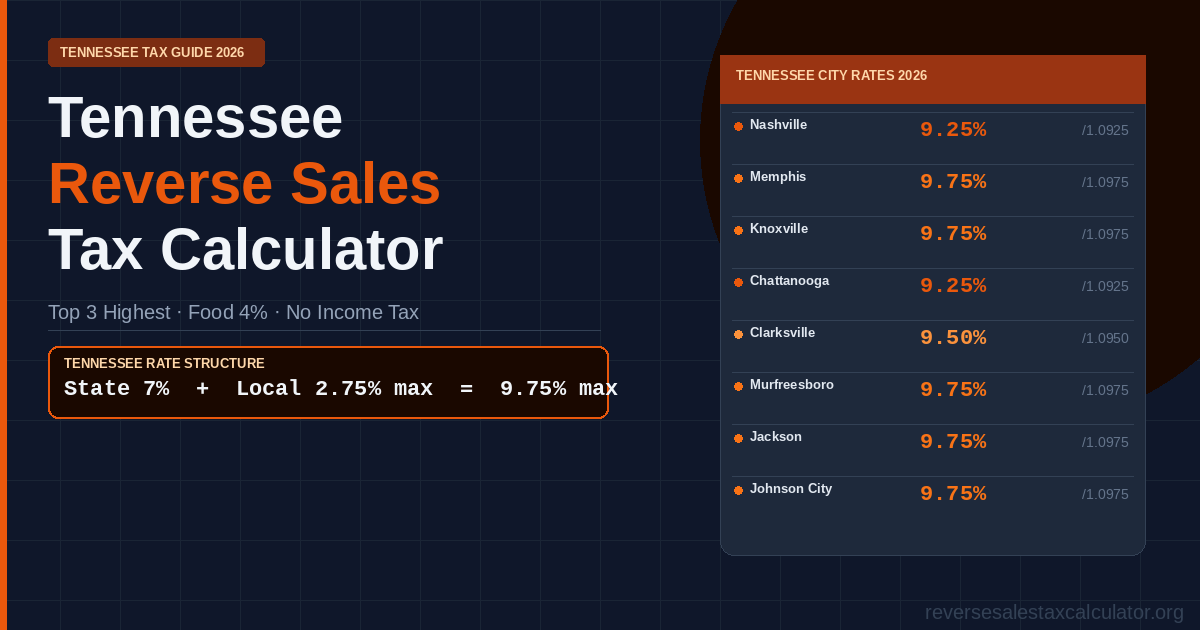
Tennessee charges a 7% state sales tax on most goods — one of the higher state base rates in the US. Counties add up to 2.75% in local tax, making the maximum combined rate 9.75%. Tennessee's average combined rate of approximately 9.55% consistently ranks it among the top 3 highest combined sales tax states in the nation, alongside Louisiana and Arkansas.
Tennessee is particularly notable because it has no state income tax (the Hall Income Tax on investment income was fully phased out in 2021), making sales tax the primary source of state revenue from individuals. Tennessee also has a unique rule: food is taxed at a reduced 4% state rate rather than being fully exempt like in many other states.
Tennessee rate structure
| Component | Rate | Who Sets It |
|---|---|---|
| State sales tax (general) | 7.00% | Tennessee State |
| State sales tax (food) | 4.00% | Tennessee State |
| Local county tax (max) | 2.75% | County |
| Max combined (general) | 9.75% | — |
| Max combined (food) | 6.75% | — |
| Statewide average | ~9.55% | — |
Reverse Calculation Formula for Tennessee
The reverse formula for Tennessee depends on whether the item is general merchandise or food:
For general merchandise: Original Price = Total ÷ (1 + Combined Rate ÷ 100)
For food items: Original Price = Total ÷ (1 + Food Rate ÷ 100)
For Memphis/Knoxville at 9.75%: Original Price = Total ÷ 1.0975
For Nashville at 9.25%: Original Price = Total ÷ 1.0925
For food in most Tennessee counties at ~6.75%: Original Price = Total ÷ 1.0675
For prescription drugs (fully exempt): No tax — pre-tax = total
Tennessee tax factors quick reference
| Combined Rate | Tax Factor | Key Locations |
|---|---|---|
| 7.00% | 1.0700 | State only — no local (rare) |
| 9.25% | 1.0925 | Nashville / Davidson County |
| 9.50% | 1.0950 | Clarksville / Montgomery County |
| 9.75% | 1.0975 | Memphis, Knoxville, Murfreesboro, Jackson |
Step-by-Step Examples
Example 1 — Electronics in Memphis (9.75%): $438.56
Total paid: $438.56. Memphis combined rate: 9.75%. Tax factor: 1.0975. Pre-tax price: $438.56 ÷ 1.0975 = $399.60. Tax: $438.56 − $399.60 = $38.96. Verify: $399.60 × 1.0975 = $438.56 ✓
Example 2 — Restaurant in Nashville (9.25%): $87.08
| Step | Calculation | Result |
|---|---|---|
| Total paid | — | $87.08 |
| Nashville rate | — | 9.25% |
| Tax factor | 1 + 0.0925 | 1.0925 |
| Pre-tax price | $87.08 ÷ 1.0925 | $79.71 |
| Tax amount | $87.08 − $79.71 | $7.37 |
Example 3 — Grocery food in Knoxville (food rate ~6.75%): $107.43
| Step | Calculation | Result |
|---|---|---|
| Total paid | — | $107.43 |
| Food rate (4% state + 2.75% local) | — | 6.75% |
| Tax factor | 1 + 0.0675 | 1.0675 |
| Pre-tax price | $107.43 ÷ 1.0675 | $100.59 |
| Tax amount | $107.43 − $100.59 | $6.84 |
Tennessee City-by-City Sales Tax Rates 2026
| City | County | General Rate | Food Rate | Factor |
|---|---|---|---|---|
| Nashville | Davidson | 9.25% | 5.25% | 1.0925 |
| Memphis | Shelby | 9.75% | 6.75% | 1.0975 |
| Knoxville | Knox | 9.75% | 6.75% | 1.0975 |
| Chattanooga | Hamilton | 9.25% | 6.25% | 1.0925 |
| Clarksville | Montgomery | 9.50% | 6.50% | 1.0950 |
| Murfreesboro | Rutherford | 9.75% | 6.75% | 1.0975 |
| Franklin | Williamson | 9.75% | 6.75% | 1.0975 |
| Jackson | Madison | 9.75% | 6.75% | 1.0975 |
| Johnson City | Washington | 9.75% | 6.75% | 1.0975 |
| Kingsport | Sullivan | 9.75% | 6.75% | 1.0975 |
| Bristol | Sullivan | 9.75% | 6.75% | 1.0975 |
| Hendersonville | Sumner | 9.75% | 6.75% | 1.0975 |
| Smyrna | Rutherford | 9.75% | 6.75% | 1.0975 |
| Bartlett | Shelby | 9.75% | 6.75% | 1.0975 |
| Germantown | Shelby | 9.75% | 6.75% | 1.0975 |
For the exact rate at any Tennessee address, use the Tennessee Department of Revenue's rate information.
Tennessee's Food Tax — Unique in the US
Tennessee's approach to food taxation is unique among US states. While most states either fully exempt groceries or tax them at the full rate, Tennessee applies a reduced 4% state rate on food — not zero, but significantly less than the 7% general rate.
What qualifies as "food" at the 4% rate
- Unprepared food items sold in grocery stores — produce, meat, dairy, bread, canned goods
- Seeds and plants used to grow food
- Dietary supplements sold as food
What does NOT qualify for the reduced food rate
- Prepared food — restaurant meals, deli items, hot food from grocery stores — taxed at full 7% state rate
- Candy — taxed at full rate
- Soft drinks and carbonated beverages — taxed at full rate
- Dietary supplements in pill/capsule form — taxed at full rate
- Alcohol — taxed at full rate plus additional alcohol taxes
The $1,600 single article cap — Tennessee's unique local tax rule
Tennessee has a unique local tax rule called the single article tax cap. For a single item costing more than $1,600, local (county) sales tax applies only to the first $1,600 of the purchase price. The state 7% applies to the full price, but county tax stops at $1,600.
Example: A $3,000 laptop in Memphis (9.75% combined = 7% state + 2.75% county). State tax: $3,000 × 7% = $210. County tax: $1,600 × 2.75% = $44. Total tax: $254 — not $292.50 that a flat 9.75% would give. The $1,600 cap saves $38.50 on this purchase.
For reverse-calculating high-value single-item purchases in Tennessee, a simple division by 1.0975 will slightly overstate the tax. The correct approach is to work backward from the split calculation above.
Tennessee Sales Tax Exemptions
Fully exempt in Tennessee
- Prescription drugs — fully exempt from both state and local tax
- Medical equipment prescribed by a doctor — wheelchairs, crutches, prosthetics
- Agricultural inputs — seeds, fertilizer, pesticides for commercial farming
- Industrial machinery — used directly in manufacturing
Taxable items that often surprise shoppers
- Clothing — fully taxable at full combined rate (no exemption)
- OTC medicines — taxable at the full rate (unlike prescription drugs)
- Candy and soft drinks — full rate
- Digital products — Tennessee taxes most digital goods including downloads and streaming
Tennessee back-to-school tax-free weekend 2026
Tennessee holds its annual back-to-school sales tax holiday July 25–27, 2026. Clothing under $100 per item, school supplies under $100 per item, and computers under $1,500 are exempt from both state and local sales tax during this weekend. This is one of the broader tax-free weekends in the US in terms of eligible items.
For Tennessee Business Owners
Tennessee Sales and Use Tax Return
Tennessee businesses file monthly, quarterly, or annual sales tax returns with the Tennessee Department of Revenue. The return requires taxable sales separated by tax rate — general merchandise (7% state) and food (4% state) must be reported separately. Local tax is then added to each category at the county rate.
The single article cap in business bookkeeping
Businesses selling high-value single items (furniture, appliances, electronics, equipment) in Tennessee must track the $1,600 single article cap carefully. POS systems should be configured to cap county tax at $1,600 per line item. Failure to apply the cap means overcharging customers on county tax — which creates refund liability.
Tennessee's no-income-tax advantage for businesses
Tennessee's lack of income tax makes it attractive for business relocation — particularly from high-income-tax states like California, New York, and Illinois. However, businesses should note that Tennessee's high sales tax rate means higher consumer prices on taxable goods, which can affect retail competitiveness for price-sensitive categories.
Excel Formula for Tennessee Sales Tax
For Memphis/Knoxville at 9.75%:
=A2/1.0975
For Nashville at 9.25%:
=A2/1.0925
For Tennessee food items (Knoxville at 6.75% food rate):
=A2/1.0675
| City | Category | Total Paid | Rate | Pre-Tax |
|---|---|---|---|---|
| Memphis | General | $438.56 | 0.0975 | =C2/(1+D2) → $399.60 |
| Nashville | Restaurant | $87.08 | 0.0925 | =C3/(1+D3) → $79.71 |
| Knoxville | Grocery | $107.43 | 0.0675 | =C4/(1+D4) → $100.59 |
Common Mistakes with Tennessee Sales Tax
- Applying the general rate to food. Tennessee food carries a 4% state rate — not 7%. Applying 9.75% to a grocery receipt significantly overstates the tax. Always check which rate applies to each item category.
- Not accounting for the $1,600 single article cap. For single items over $1,600, county tax only applies to the first $1,600. Dividing a $3,000 receipt by 1.0975 gives the wrong pre-tax amount because the flat rate assumption breaks down at this price point.
- Treating OTC medicines like prescription drugs. Prescription drugs are fully exempt in Tennessee. OTC medicines are taxable at the full rate. A pharmacy receipt mixing both requires separate treatment.
- Assuming Nashville and Memphis have the same rate. Nashville is 9.25% while Memphis is 9.75% — a half-percentage-point difference that matters on large purchases. Always use the city-specific rate.
- Forgetting Tennessee taxes digital products. Downloads, streaming services, and digital subscriptions are taxable in Tennessee at the full combined rate. Reverse-calculating a Tennessee digital receipt should use the full 9.25%–9.75% rate.
Tennessee vs Neighboring States
Tennessee at 9.55% average consistently ranks among the top 3 highest combined sales tax states. Neighboring states offer lower rates in most cases: Kentucky averages 6%, North Carolina averages 6.98%, Virginia averages 5.73%, and Georgia averages 7.32%.
Arkansas at 9.47% and Mississippi at 7% are the other close neighbors. For large purchases, residents near state borders often find meaningful savings by shopping across state lines — particularly along the Tennessee-Kentucky and Tennessee-Virginia borders.
Use our Tennessee reverse sales tax calculator for instant results on any receipt, or check the full state directory for every US jurisdiction.
Frequently asked questions
Tennessee's state sales tax rate is 7% on general merchandise. Counties add up to 2.75% local tax, making the maximum combined rate 9.75%. Memphis, Knoxville, and Murfreesboro charge 9.75%; Nashville charges 9.25%. Tennessee's average of ~9.55% ranks it among the top 3 highest combined tax states in the US.
Divide your total by the tax factor for your city. For Memphis at 9.75%: $438.56 / 1.0975 = $399.60 pre-tax. For Nashville at 9.25%: $87.08 / 1.0925 = $79.71 pre-tax. For food items, use the lower food rate factor.
Yes, but at a reduced rate. Tennessee applies a 4% state tax on qualifying food (groceries) rather than the full 7%. Local county tax is also applied at a reduced rate on food, making the effective food rate approximately 5.25%–6.75% depending on the county. Restaurant meals and prepared food are taxed at the full rate.
Tennessee's single-article tax cap limits county (local) sales tax to the first $1,600 of any single item. The state 7% still applies to the full price, but county tax stops at $1,600. This saves money on high-value single purchases like furniture, appliances, and electronics over $1,600.
No. Tennessee fully phased out the Hall Income Tax on investment income in 2021. Tennessee has no personal income tax on wages or investment income, making sales tax the primary individual tax burden — which is why Tennessee's rates are among the highest in the US.
Tennessee's back-to-school tax-free weekend is July 25–27, 2026. Clothing under $100 per item, school supplies under $100, and computers under $1,500 are exempt from both state and local sales tax during this period.